The Entity System
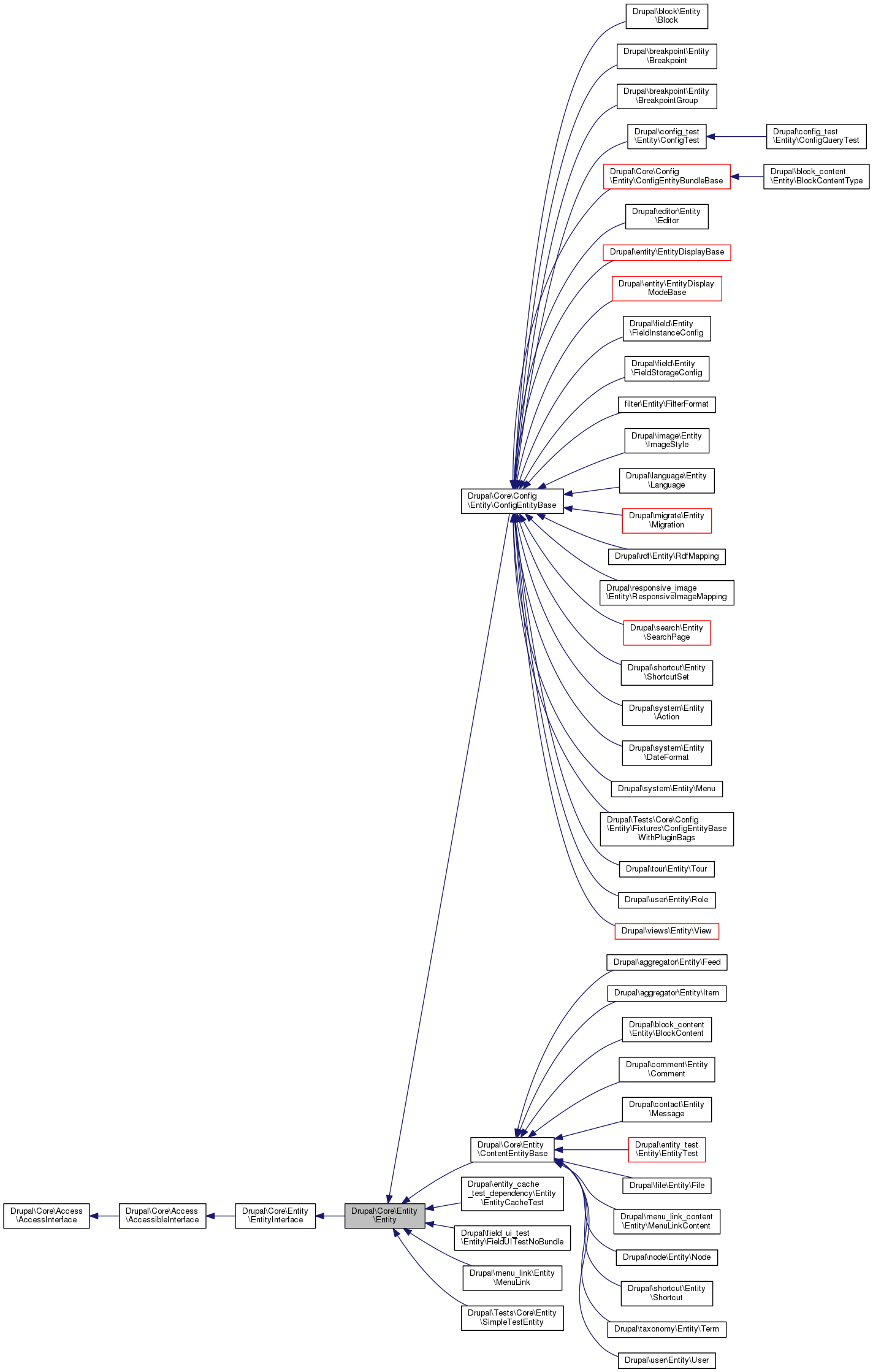
Entities, in Drupal, are objects that are used for persistent storage of content and configuration information.
See the Information types topic for an overview of the different types of information, and the Configuration API topic for more about the configuration API.
Each entity is an instance of a particular "entity type".
Some content entity types have sub-types, which are known as "bundles", while for other entity types, there is only a single bundle.
For example, the Node content entity type, which is used for the main content pages in Drupal, has bundles that are known as "content types", while the User content type, which is used for user accounts, has only one bundle.
The sections below have more information about entities and the Entity API; for more detailed information, see https://www.drupal.org/developing/api/entity.
Drupal 7 - entities were generic stdClass objects.
Drupal 8 - entities are now specifically typed objects, with each entity type defining a class that will be used for instances of the given entity.
Entity Query API
Using Drupal Entity Query allows for efficient and simplified data retrieval from the Drupal database, abstracting complex SQL queries.
Entity Query API is secure against SQL injection, promoting best practices in query construction for performance and security.
Advanced techniques like logical operators and aggregate functions enhance the capabilities of data retrieval in Drupal development.
Addressing common challenges like handling large result sets and caching query results improves the reliability and efficiency of Drupal applications.
Drupal Entity Query allows for efficient data retrieval and management within Drupal's architecture.
Understanding its functionality and application is essential for effective development and customization in Drupal projects.
Drupal Entity Query is an API tailored for querying and retrieving data from the Drupal database.
This powerful tool abstracts complex SQL queries, offering a simplified approach to access and display content.
Entities, the core data structures in Drupal such as nodes, users, and taxonomy terms, are efficiently managed using this API.
Here few Examples
$query = Drupal::entityQuery('node');
$query->condition('status', 1); // Active nodes
$query->condition('type', 'article'); // Of type 'article'
$result = $query->execute();
$query = Drupal::entityQuery('node');
$query->condition('created', [strtotime('2020-01-01'), strtotime('2020-12-31')], 'BETWEEN');
$result = $query->execute();
$query = Drupal::entityQuery('node');
$query->condition('status', 1);
$query->sort('created', 'DESC'); // Sort by creation date, newest first
$result = $query->execute();
$query = Drupal::entityQuery('node');
$query->condition('type', 'article');
$node_ids = $query->execute();

// check if empty
if (!empty($node_ids)) {

	// Load nodes from the returned IDs
    $nodes = Drupal\node\Entity\Node::loadMultiple($node_ids);
} else {
    // Handle the case where no nodes are found
}
$query = Drupal::entityQuery('node');
$group = $query->orConditionGroup()
               ->condition('status', 1)
               ->condition('promote', 1);
$query->condition($group);
$node_ids = $query->execute();
$query = Drupal::entityQuery('node');
$query->condition('field_indexed_example', 'value');
$node_ids = $query->execute();
$result = \Drupal::entityQuery('node')
 ->condition('type', 'movie')
 ->condition('field_director.entity:node.field_birth_year', '1981')
 ->execute();

Code Snippet
$query = \Drupal::entityQuery('node')
  ->condition('type', 'page')
  ->condition('field_some_field', 14)
  ->accessCheck(TRUE);
$results = $query->execute();